Al Gore and Alexandria Ocasiocortez Funny Facebook
If y'all buy something from a Vox link, Vox Media may earn a commission. See our ethics statement.
Update, 3/xxx/2019: Sen. Ed Markey (D-MA) and Rep. Alexandria Ocasio-Cortez (D-NY) introduced a Green New Deal resolution on Feb 7 that lays out the goals, aspirations, and specifics of the programme in a more definitive way. Read about it here, and read about the criticism that followed here and here. The Senate voted the resolution downwards on March 26, only Ocasio-Cortez is now drafting a serial of smaller, related bills. Our initial explainer, showtime published on December 21, follows.
If the contempo study from the Intergovernmental Console on Climate Change is to exist believed, humanity has merely over a decade to get carbon emissions nether control before catastrophic climate change impacts become unavoidable.
The Republican Party generally ignores or denies that trouble. Simply the Democratic Party claims to accept and understand it.
It is odd, then, that Democrats do not take a plan to address climate modify.
Their terminal big plan — the American Clean Energy and Security Act — passed the Business firm in 2009 merely went on to die an unceremonious decease before reaching the Senate floor. Since and then, at that place's been zip to replace it.
Enough of Democratic politicians support policies that would reduce climate pollution — renewable free energy tax credits, fuel economic system standards, and the like — but those policies practice non add up to a comprehensive solution, certainly zero like what the Intergovernmental Panel on Climate Alter (IPCC) suggests is necessary.
Young activists, who will be forced to live with the ravages of climate change, discover this upsetting. And so they take proposed a plan of their ain. Information technology'due south chosen the Green New Bargain (GND) — a term purposefully reminiscent of Franklin Delano Roosevelt's original New Deal in the 1930s — and it has get the talk of the town. Here are Google searches from the past few months:
:format(webp):no_upscale()/cdn.vox-cdn.com/uploads/chorus_asset/file/13643152/Screen_Shot_2018_12_21_at_7.51.13_AM.png)
For this story, I talked to wonks and political activists who are working on the GND, and without exception, they expressed surprise at the speed and intensity with which both media attending and activist energy have centered on information technology. There is a sense amongst those involved that they have caught a tiger by the tail.
The GND push button has thrust climate change into the national conversation, put House Democrats on find, and created an intense and escalating bandwagon event. Politicians (nigh recently 2020 presidential aspirant Cory Booker), advocates (nearly recently Al Gore), wonks, and activists — everyone involved in green politics is talking almost the GND.
Simply ... WTF is it?
As we will see, the exact details of the GND remain to be worked out, merely the broad thrust is fairly simple. It refers, in the loosest sense, to a massive program of investments in make clean-free energy jobs and infrastructure, meant to transform non just the free energy sector, merely the entire economy. It is meant both to decarbonize the economy and to make it fairer and more just.
But the policy is just function of the motion picture. Just as hitting are the politics, which seem to take tapped into an enormous, untapped demand for climate ambition.
When I call back virtually the social condition of the GND, I am struck by an analogy: It'southward a bit like concentrated solar power. (I'1000 an energy nerd. Sue me.) In a full-bodied solar power plant, large arrays of mirrors reflect sunlight onto a single tower, heating the fluid within it. The fluid transfers heat to water, the steam from the boiling fluid drives a turbine, and the turbine generates electric ability.
:format(webp):no_upscale()/cdn.vox-cdn.com/uploads/chorus_asset/file/6099425/DOE-LPO_Illustrated-Posters_01_CSP_Full_533x800_0.0.jpg)
The GND is the tower, and all the sudden, all the mirrors are aligned, focused on it. The rut is edifice, the water is chop-chop reaching a eddy. Meanwhile, its owners are racing to build a turbine.
At that place is immense potential energy in the GND, a concentration of social attending and intensity. Just converting that heat to power — to existent results on the ground — will involve a great deal of political and policy technology, almost all of which lies alee.
The GND has great potential, simply and so, American political history is a long story of wasted potential, of waves of progressive enthusiasm breaking on the rocky shores of Washington, DC, to no lasting effect. Whether that fate awaits the GND depends on many things, amongst them whether President Donald Trump — the culmination of a history of total Republican intransigence and ugliness the stretches over immature activists' entire adult lives — has changed the political landscape enough that Democrats might leave backside their long defensive hunker and vocalization some appetite.
Before jumping in, it's worth noting that a number of great journalists take blazed the trail on this story already. Come across, in detail: Kate Aronoff'southward work, here and here but particularly, for the big picture, here; Hannah Northey and the crew at E&E are all over the daily developments; Alexander Kaufman at Huffington Postal service keeps rail of the politics; and Rob Meyer at the Atlantic always has good thoughts. (In that location are no doubt many others I'one thousand forgetting.)
To get a handle on the GND, let's have a spin through its history, the role it'due south playing in current politics, the effort to dorsum it up with a existent policy program, and the many, many challenges facing information technology before it can become legislation.
The GND concept is not new
The get-go utilize of the term "GND" in the US may trace to New York Times columnist Thomas Friedman, who called for one in a 2007 column (and in his book Hot, Flat, and Crowded) as a kind of green globalism. (Funny thing, politics.) As Kaufman notes in a story on this history, none other than Barack Obama was taken past Friedman's idea and included a GND in his 2008 platform. (It tin as well be argued that Obama's stimulus bill was a proto-GND in itself.)
Around the same time, in 2007, British economist Richard Murphy began discussing a GND and founded the Dark-green New Deal Group, which funneled some ideas to the Labour Party. The UN also took up the idea, calling for a global GND in 2009.
But then Tories won in the UK in 2009, the Republicans swept the 2010 midterms, and the idea by and large went quiescent, at least among politicians.
In 2016, a GND became the centerpiece of the Green Party presidential entrada of Jill Stein; indeed, a GND has been function of the U.s. Green Party's platform for over a decade. (Information technology is too central to the platform of the European Greens — come across this report from the Wuppertal Institute.)
Bernie Sanders'south 2016 campaign included a GND. And then, in the 2018 midterms, Alexandria Ocasio-Cortez, now a representative-elect, took it up.
:format(webp):no_upscale()/cdn.vox-cdn.com/uploads/chorus_asset/file/11936425/GettyImages_1004430958.jpg)
But that capsule history of the term itself, the brand, somewhat sells brusk the intellectual lineage. Many pieces of the GND take been worked on by many people over the years. The constituent ideas — 100 percent clean energy; a just transition to a new, meliorate economy; massive public sector investments — are not new.
Talk of a "bluish-green alliance" between labor and environmentalists, built around public infrastructure investments and new jobs, goes all the way dorsum to 2000 presidential candidate Ralph Nader; real work has been underway at to the lowest degree since 2006, when the, er, Blue-Green Alliance was established. The AFL-CIO has its ain big infrastructure plan.
Van Jones wrote a book about green jobs back in 2008 and even worked briefly as an Obama green jobs adviser, before a right-wing smear campaign drove him from the administration. The whole green-economy frame almost took root, but one time the Dems went on the defensive in 2010, it faded to the background.
In Washington state this year, activists ran a ballot initiative that coupled a carbon tax with a GND-style plan of investments, merely, in the face of $xxx million of oil money, it went downwards to defeat.
Nonetheless, the basic GND ideas have persisted. And their appeal only grew equally climate warnings became more dire. They were in the collective water, like an oversaturated solution, but waiting for a particle around which to crystallize.
That particle came in November.
The GND comes to Washington
Afterwards the 2016 race, some of the folks who worked on the Sanders entrada started an system called Make New Congress, with the audacious (some might say insane) goal of recruiting 400 fresh new faces to run for, and accept over, Congress. Part of the shared platform was an ambitious, WWII-style mobilization on climate change (though non nevertheless branded GND).
That effort did not result in a congressional takeover, but it was not without fruits. Brand New Congress spun off a grouping called Justice Democrats that went on to recruit several winning candidates like Rashida Tlaib, Ilhan Omar, and Ayanna Pressley.
Among them was Ocasio-Cortez, the young bartender who ran against incumbent centrist Democrat Joe Crowley in the New York'due south 14th District primary. The co-founder of Brand New Congress, Saikat Chakrabarti, became Ocasio-Cortez's co-campaign manager. (As of January, he will be her chief of staff.) And Ocasio-Cortez, who was already committed to putting climatic change at the pinnacle of her agenda, eagerly embraced the green mobilization programme and began using the GND branding.
And so came the first week of orientation for new members of Congress.
:format(webp):no_upscale()/cdn.vox-cdn.com/uploads/chorus_asset/file/13643075/AP_18319512937185.jpg)
Several things came together that week. Shortly prior, the IPCC had released its latest report, with the ominous news that humanity has merely over a decade to peak and begin rapidly reducing global carbon emissions if there is to be any hope of hit the (already inadequate) international target of limiting global temperature rising to no more than 2 degrees Celsius.
There was already enormous energy and mobilization on the left, thanks to the ballot, and young activists were keen to push button climate change to the elevation of the calendar.
And so a piece in the Hill reported that House Democrats had no plans to movement on climate change, which appeared nowhere in their list of priorities. Meanwhile, House Minority Leader Nancy Pelosi started talking the day after the election nearly a "bipartisan market place of ideas," which is not exactly what you'd call reading the room.
Pelosi signaled that she planned to revive the Select Commission on Energy Independence and Global Warming (2007 to 2011, RIP), but activists and the incoming class of social democrats wanted something much bolder.
They didn't encounter any point in pursuing cooperation with Republicans, a strategy that has proven fruitless for a decade. And they didn't want climate policy tucked away in a committee that would do nothing but hold hearings and discuss how existent global warming is (spoiler: and then existent).
But information technology gave them something to ask for. They couldn't very well need the total GND earlier the new Congress was even sworn in. But they could ask for a delivery.
So the Sunrise Motion, a youth-led arrangement organizing around a GND, planned a sit-in in Pelosi's office, to demand a committee with teeth — a committee that would be charged with actually developing a plan to see the aggressive targets implied by the IPCC report.
Sunrise approached Ocasio-Cortez to ask if she might assist publicize the event, maybe with a tweet. Instead, she vowed to show up. She and her team had been casting effectually for some early fashion to push button the GND into the public consciousness and onto the Democratic agenda.
Working together, Sunrise, Ocasio-Cortez, and the Justice Democrats quickly hashed out a proposal for a Select Committee on a Green New Bargain, outlining their vision for the kind of plan such a committee would produce.
Sunrise brought close to 200 young activists to Pelosi's part on November 13. Ocasio-Cortez, taking a intermission from orientation, stopped past to rally them and show her support. The media swarmed.
In retrospect, though it came together on the fly, the timing was fortuitous. The elections were over; there was no presidential election yet; Trump hadn't tweeted in a few whole minutes; the political press was bored. The IPCC had put climatic change in the news. And the prospect of a young, newly elected, not-yet-sworn-in progressive representative leading a youth protestation confronting her leaderhoped-for proved irresistible.
In the ensuing weeks, Ocasio-Cortez and Sunrise pushed incoming members of Congress to sign on to the GND Select Committee plan. On December ten, in that location was another sit-in in Pelosi's office, this fourth dimension with activists stretched out the door. By the end, 40 members of Congress — including several notable senators like Booker, Sanders, and Jeff Merkley, each a potential 2020 presidential candidate — signed on to support the committee.
— Sunrise Movement (@sunrisemvmt) Dec 19, 201840 Representatives at present back the Select Committee for a #GreenNewDeal -- one of the most ambitious economic and climate policies e'er discussed in Congress.
Our organizing is working. We're changing politics in America.
✊ ✊ ✊ ✊ ✊ pic.twitter.com/31noqJMCB3
It was an activist campaign edifice momentum for serious climate action, and information technology was making headlines.
Dem leadership gives activists the stiff arm
All the same, it seems Democratic leadership was non particularly happy about a group of upstarts laying merits to a major issue and instructing the caucus how to approach it. Pelosi largely gave Ocasio-Cortez and activists the cold shoulder. They were not warned before Steny Hoyer announced on Wednesday that the committee volition not take subpoena ability. And they were non warned before it leaked on Th that Rep. Kathy Castor of Florida had been chosen to head the committee, which would in fact exist the same old select committee on climatic change.
Equally for the GND? "I think they have some terrific ideas," Castor said, all but patting activists on the head. "But that's not going to exist our sole focus."
What about the activists' other major demand, that no one who accepts fossil fuel money exist allowed on the committee? "I don't call back you can do that nether the Showtime Amendment, actually," she said.
She later admitted to Kaufman at the Huffington Post that this peculiar bit of constitutional interpretation was "inartful," and she simply doesn't know if she tin practise that equally chair of the committee. She says maybe she'll talk it over with the caucus.
This is a articulate rebuke from Pelosi and Hoyer, non only cutting short a growing activist campaign, without alert, on the eve of the holidays, only also appointing a committee chair who isn't briefed on the debate around the committee, is reliable but undistinguished on environmental issues, and clearly hasn't been prepared for the activist fury that awaits her. (It doesn't seem particularly fair to Castor, either.)
:format(webp):no_upscale()/cdn.vox-cdn.com/uploads/chorus_asset/file/13603553/1073950334.jpg.jpg)
"They're non willing to get out on a limb unless they're confident that they have the full support of the conclave," says Evan Weber, a co-founder of Sunrise, "which for the states is disappointing simply not all that surprising."
"What we idea was, let's try to get the smallest possible matter done, which is get all Democrats to concord that we should make a plan," says Chakrabarti, but even that "isn't so easy."
Here'due south a revealing fact well-nigh this clash.
Though Chakrabarti may consider it the "smallest possible thing," anyone who glances at Ocasio-Cortez'southward document will realize that it is far from small-scale or piece of cake. It doesn't just call for a committee. Information technology says that no one who receives any fossil fuel funding may serve on the committee (which would rule out a adept swath of senior Democrats).
Information technology requires that the committee produce a program that fully decarbonizes the economic system, invests trillions of dollars, and provides a federal job guarantee, while addressing and mitigating historical inequalities. (Oh, and it might also include such "boosted measures such equally bones income programs [or] universal health care programs.")
In short, it charges the commission with developing a plan of vaulting appetite and complication. If representatives were mainly focused on policy, some might have raised cautions along these lines.
Simply neither Chakrabarti and Weber has heard any policy objections. No one has asked virtually, say, the federal jobs guarantee. Rather, the objections take been almost entirely about turf.
As Weber says, "sure politicians who were not excited almost whatsoever select committee" claimed that the commission'due south jurisdiction would override the jurisdiction and authority of existing committees.
— Alexandria Ocasio-Cortez (@Ocasio2018) December 19, 2018Our ultimate terminate goal isn't a Select Commission.
Our goal is to treat Climate Change similar the serious, existential threat it is past drafting an ambitious solution on the scale necessary - aka a Greenish New Deal - to get it done.
A weak committee misses the point & endangers people. https://t.co/LIMkPru6wU
The proposal never meant to assign the select committee the power to introduce legislation, Weber says, but to make members more than comfy, language was added clarifying as much. The committee could just produce a plan, as draft legislation for other committees to take up or not as they come across fit. "For us," Weber says, "the more important affair for the draft legislation was always to have a platform for candidates to run on in 2020."
Merely in the terminate, the dispute was less about concrete issues of jurisdiction than a bulletin to newcomers. Every bit E&E reports, "many Democratic lawmakers say the console could be a landing place for many of the freshmen members who have said they'd similar to be on Energy and Commerce." The youngsters tin take a committee to hold hearings and make headlines. Every bit for legislation, we adults have got that covered.
Would Ocasio-Cortez have a spot on the committee? "She doesn't desire to be on a committee just for the sake of being on a committee," says Chakrabarti.
:format(webp):no_upscale()/cdn.vox-cdn.com/uploads/chorus_asset/file/13643078/973240652.jpg.jpg)
What's adjacent for the GND
Though the committee fight was discouraging (and not everyone agrees about its tactical wisdom), its reverberations reached well across DC. It produced an enormous jolt for the movement.
All the sudden, the left has found something it had lacked for years: an ambitious, positive climate program, something equally bold and catchy equally "Medicare-for-all" in health care. Advocates and activists are on board and wonks are thinking near the mechanics.
"Nosotros thought it would take a year" to get a motion going around the GND, Chakrabarti says. Instead, "it took weeks."
Leaders have a few ideas about what to exercise adjacent, including the possibility of a GND caucus in the Business firm (after all, the membership has already mostly identified itself) and continued direct action.
Just the summit priority after the holidays is to begin the process of putting real policy meat on the GND bones — hammering out an actual policy platform.
"If they're not going to develop the programme," Weber says. "We will. We'll go together the scientists, the engineers, the community leaders, the mayors and city councilors, create the plan ourselves, and go out and build the public and political support to make information technology happen over the side by side two years."
As Weber concedes, "GND" tin can hateful just most anything at the moment. At present the race is on to go far hateful something in particular — to produce something that activists and wonks can agree on, that politicians can run on, and that the public tin rally around.
:format(webp):no_upscale()/cdn.vox-cdn.com/uploads/chorus_asset/file/13643070/Sunrise_Pelosi_office_action__11.13.18__Rachael_Warriner_28.jpg)
A new think tank will transform the GND into a policy platform
As of at present, the movement's simply "official" version of the GND is the Ocasio-Cortez certificate. Equally sweeping and ambitious equally it is, it is less a policy platform than a set of high-level goals. Each ane (e.g., "decarbonizing, repairing, and improving transportation and other infrastructure") would entail dozens of policies, at different levels of authorities.
The first and thus far simply serious endeavor to fill out the policy side came in a written report from Greg Carlock at the upstart call back tank Data For Progress. But even that report is less a specific prepare of policy choices than an extensive policy bill of fare — a prepare of options for each of the program'southward large-calibration goals, everything from building standards to new techniques in agriculture to investments in transit. It is something similar a detailed snapshot of the policy mural, from which an architect could bricolage together a plan.
It is also a narrative tying those goals together, and its central theme — the central theme of all contemporary GND work — is that the GND is not just a climatic change policy. It is a vision for a new kind of economy, built around a new set of social and economic relationships. Information technology is not merely a way to reduce emissions, only also to ameliorate the other symptoms and dysfunctions of a late capitalist economy: growing inequality and concentration of power at the height.
"Climate change is an emergent property of a bad economic system," Carlock says. That outmoded economic system — the nebulous ready of assumptions and power relationships that goes under the proper name "neoliberalism" — is the existent target of the GND.
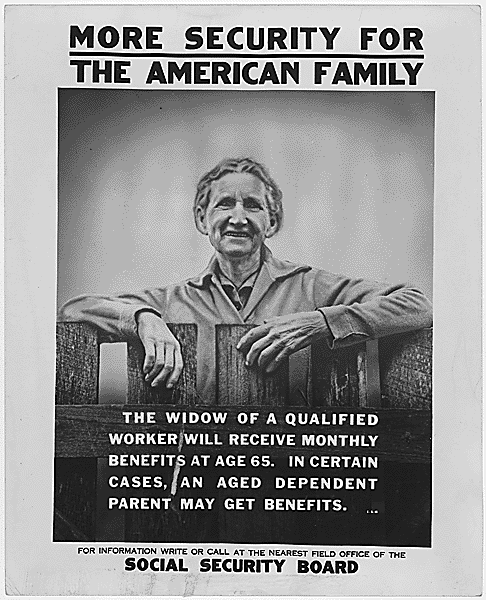
The GND is, at its middle, a class of social-democratic populism. Its intent is to involve the entire citizenry in the shared project of adapting to the 21st century, and in so doing materially improve the quality of life of the poor and middle class. Information technology is an endeavor to rebalance the economy and the political organization, away from a monomaniacal focus on individual goods, toward a more than generous view of public goods and public purpose.
:format(webp):no_upscale()/cdn.vox-cdn.com/uploads/chorus_asset/file/13643079/Signing_Of_The_Social_Security_Act.jpg)
At to the lowest degree that'south the idea. But getting from that idea to concrete policy platform that various constituencies can rally around (and a broad array of Democrats tin endorse) will exist a fragile and charged undertaking. Making those fraught policy choices is largely going to autumn on the shoulders of a young policy annotator whose proper noun I suspect yous will exist hearing much more of: Rhiana Gunn-Wright.
Gunn-Wright, who served as policy director on the insurgent gubernatorial campaign of Abdul El-Sayed in Michigan, works for a relatively new policy store called New Consensus, which spun off every bit the policy arm of Justice Democrats. At to the lowest degree through 2020, its sole focus is to put together a policy platform that Democrats could, in theory, pass into law in 2020. (Northey has a expert story on New Consensus.)
Organizer Demond Drummer will serve as the executive manager, but Gunn-Wright will lead the GND effort.
Apparently, figuring out how to fundamentally transform the world'due south largest economy is a lot for one person to take on. When I asked Gunn-Wright if she knows what she'due south gotten into, she laughs. "Information technology'due south really heady!"
I heard grumbling here and there most the responsibility for policy beingness given over to a new store, rather than to the many people and organizations that accept been working on these issues, but Gunn-Wright is at pains to explain that she is not setting out to write a GND on her own.
"This requires an incredible amount of policy knowledge, more than one group, definitely more than than one person can bring to bear," she says, "so the hope is that it can exist a foundation for supporting enquiry."
The idea is to convene experts and activists to discuss a shared vision, prescriptive on some matters, but offering a menu of options on others. The issue will be a platform, a way of using "policymaking as a grade of organizing," and then that even wonks doing deep piece of work on a particular piece or activists rallying around an private boxing can be "connected to the larger framework and programme," she says.
To a higher place all, she says, New Consensus is eager to "move forwards in advice and in alignment."
When I noted that the transportation goals in the GND so far have been pretty broad and aspirational, Gunn-Wright made it clear that these issues accept been on her heed lately.
"What does it mean for light-duty electric vehicles?" she asked. "How are nosotros dealing with aviation? How are nosotros dealing with aircraft? Where do hydrogen fuel cells fit in? How are we getting states to assemble and get fleets large enough to do these deployments? How are nosotros dealing with school buses?" (This went on for several minutes.)
:format(webp):no_upscale()/cdn.vox-cdn.com/uploads/chorus_asset/file/13643097/blue_bird_re_electric_bus_elektrobus_school_bus_02.png)
Or how almost electricity? Currently, Gunn-Wright said, New Consensus is "partnering with some analysts to model what it looks similar if you take a national [renewable portfolio standard] and a carbon taxation. How do those ii things interact? What'southward the result on emissions? What is the economic effect?" (This too went on for several minutes.)
I delighted in the wonkery, but Gunn-Wright also returned the conversation once again and over again to the effects of the plan on ordinary people, peculiarly the poor and vulnerable. "I spent a little bit of time as a [user experience] researcher," she says, "then my team also thinks about the terminate user." How does the average citizen discover a suitable job, or get help putting solar panels on their roof?
"If you lot accept more money or access to ability, you lot tin can either opt out or pay to make it simpler," she says. "The people who will take to go through all the mess are generally poorer people, with the least admission to power."
Gunn-Wright'southward command of the issues, coupled with her unapologetic belief in the public sector to "shape markets and direct innovation," coupled with her axiomatic concern for the low-income and working classes, make me excited to see what New Consensus produces.
Yet it remains an almost outlandishly aggressive undertaking: to coordinate and develop a coherent policy platform that can guide a transformation of the economy, decarbonize every economic sector, guarantee every American a well-paying job with skillful benefits, strengthen the resilience of the country's almost vulnerable communities, command the back up of politicians from every region of the land, and inspire enthusiasm and activity among activists.
Simply Gunn-Wright is optimistic. "I've never worked on a policy issue where I was met with so much good will, people who volition share information, people willing to leverage their talents and have conversations," she says. "That gives me a lot of hope."
So it withal remains to hammer out a specific GND. But that doesn't mean there's no substance to it at all. At least among the movement around Sunrise and Ocasio-Cortez, there is a substantial caste of consensus most the core elements.
The 3 core principles of the GND: decarbonization, jobs, and justice
I asked the same question of anybody I talked to: What are your lesser lines? What must be in a policy platform for information technology to earn the name GND? Answers varied considerably in their details and accent, but they amassed around three bones principles.
i) The program must decarbonize the economy.
The young people who will have to live with the effects of climate change want a programme that begins with what is necessary rather than what is deemed politically possible. "We want the policy to match the findings in the IPCC report — to lucifer the scale of the trouble," says Waleed Shahid of Justice Democrats. Or every bit Gunn-Wright puts it, "Nosotros need to get all the way."
That ways decarbonizing the Usa economy: getting the electricity sector to zero carbon as soon every bit possible and other sectors shortly thereafter. That is a gargantuan undertaking that will impact every American life.
Ocasio-Cortez'due south platform calls for 100 percent renewable electricity inside 10 years, only very few policy experts believe that is possible. Carlock, along with most other wonks in the field, thinks information technology's preferable to shoot for 100 percent "clean and renewable energy," to make room for not-renewable carbon-free options like existing nuclear plants or whatever new developments in nuclear, biomass, or carbon capture and sequestration. And they also think it's best to push the target out a chip. (Carlock has information technology at 2035.)
Finding feasible and price-effective paths to a carbon-gratuitous grid is equally important as ever! For guidance, @max_energy @samthernstrom & I reviewed 40 academic studies charting course to a decarbonized ability arrangement & synthesized findings in a paper merely published in the journal Joule. moving-picture show.twitter.com/RbxOTQ0yHb
— JesseJenkins (@JesseJenkins) December xi, 2018
Other energy applications will be fifty-fifty more challenging than electricity. Decarbonizing transportation will involve radically accelerating the spread of electrical vehicles, possibly past banning gasoline and diesel vehicle sales by 2030, and figuring out what to exercise with aviation and heavy transport.
Buildings produce about 40 percent of almanac US carbon emissions. Decarbonizing buildings will involve implementing zero-carbon standards for all new buildings and funding the wholesale retrofitting of existing buildings, millions of which use fossil fuels like natural gas for heating and cooling.
And then there'south heavy industry, where decarbonization remains something of a mystery, the piece of work barely begun.
And on and on. Ocasio-Cortez's plan actually calls for decarbonizing not simply electricity but the entire Us economy in 10 years, which is nearly certainly impossible absent radical reductions in Americans' energy consumption, something like imposed austerity — and nobody thinks Americans are that scared of climatic change. Even decarbonizing the economy by 2050, every bit Carlock's study calls for, is an extraordinarily daunting challenge, involving hundreds of discrete policy bug, each facing their own dilemmas and entrenched interests.
two) The plan must include a federal jobs guarantee and large-calibration public investments.
Again, the GND is non merely climate policy. It's about transforming the economy, lifting the upwards the poor and middle class, and creating a more muscular, active public sector.
The GND "opens an opportunity to renegotiate power relationships between the public sector, the private sector, and the people," says Gunn-Wright. "We are interested in solutions that create more democratic structures in our economy."
Weber says that the key is to "connect [the GND] inextricably to the economic hurting that so many Americans still feel, and show people that there's a way to build a better economy and improve their lives through activity on climate change."
To that finish, the GND would involve large-scale investments, on the order of trillions of dollars over 10 years, alongside a federal jobs guarantee. A job paying at least $15 an hour, with skillful benefits, would exist available to anyone who wanted one.
Politically, this is the key to the GND. It's a program that can involve everyone and aid everyone — and, theoretically, gain support from everyone, even those in red states who do not care about climate change. The investments and the job guarantee take the GND out of the realm of environmental policy and move information technology into the realm of transformational economical policy.
:format(webp):no_upscale()/cdn.vox-cdn.com/uploads/chorus_asset/file/13643081/Wpa1.jpg)
But policy-wise, this is also, in many means, the least cooked piece. The federal job guarantee has substantial support among wonks (here's an statement in favor from scholars at the Levy Economics Establish), just too a good scrap of opposition. (Matt Bruenig runs through some of the objections; Josh Bivens of the Economic Policy Institute argues for other ways of reaching full employment.)
The mode to call back about the basic problem is: You're attempting to train and utilize everyone who happens to want a job at the moment — a constantly fluctuating flow of people with differing skills, who will demand jobs for differing periods of time. You're trying to provide those jobs through a massive programme of investments. Just what sorts of investments provide piece of work for a job forcefulness of perpetually shifting skills and composition? Specifically, what subset of those investments are both "green" and suitable for a morphing, countercyclical job force?
It'southward not as easy to spend money and employ people as it might seem. Carlock has numerous investment ideas in his report (stuff like brownfield restoration and tree-planting), simply even if enough ideas can exist found, administration, which would be spread out in land offices and community centers across the country, remains daunting.
"The idea that thousands of administrations across the country will be able to usefully employ random flows of labor with random sets of skills in random durations is fairly implausible," argues Bruenig.
Gunn-Wright notes that there are many paths to a jobs guarantee, some incremental. Both the jobs and investment pieces could exist phased in, expanded through testing and experimentation. "Airplane pilot and scale," Carlock says.
Nevertheless, at the very least, there's a practiced bit of policy work ahead for this (politically central) element of the programme to become practicable legislation.
three) The program must include a just transition.
Several people I talked to stressed that they desire to avert the mistakes of the original New Bargain, many elements of which entrenched or exacerbated racial inequalities. Anybody wants to make sure that the plan includes protections for those hardest hit by historical discrimination and those set to endure virtually from the furnishings of climate change — in Ocasio-Cortez's certificate, "low-income communities, communities of color, indigenous communities, [and] the forepart-line communities about affected by climatic change, pollution, and other environmental harm."
Role of that is workforce preparation and the chore guarantee, part of it is ensuring that all those jobs come with strong labor, environmental, and nondiscrimination standards, part of it is investments in those communities to fund programs like atomic number 82 remediation, and part of it is making certain that all the investments — that all parts of the GND — follow strong ecology-justice standards.
Beyond these 3 cadre principles, the GND is nevertheless capacious enough to include a wide variety of preferences and perspectives. Journalist Aronoff best expresses the maximum, self-avowedly socialist version, painting an idyllic movie of a family provisioned with publicly funded work, child care benefits, and elderberry care. The Sierra Lodge has a somewhat more small-scale version.
As the GND make spreads, traditional advocacy and policy groups are likely to break off more manageable chunks nether the same rubric. After all, the GND is so sweeping that virtually whatsoever climate policy tin can claim to exist part of it.
The delicate dance is to keep the GND fuzzy enough to permit a broad coalition of people and interests to encounter themselves in it — which is, somewhat miraculously, what seems to have happened and so far — while specifying it enough to avert having it watered down into a experience-skilful buzzword.
And that has to be done while navigating all the prodigious challenges alee.
The tiptop three challenges facing the GND: paying for it, disarming the public, and winning over Democrats
As you've probably gathered by at present, the GND is much more than aggressive than most policy ideas that have been bouncing around Washington, DC, the past few decades. Moving information technology from idea to legislation will involve overcoming obstacles nigh too numerous to list.
Because the GND is, at its core, an statement for radical change, it is sure to inspire reaction — a defense force of the status quo. And every bit Albert Hirschman wrote in his 1991 book The Rhetoric of Reaction, the arguments will cluster around the iii core reactionary themes (quoting Hirschman): "futility — the claim that all attempts at social engineering are powerless to alter the natural order of things; perversity — the argument that interventions will actually backlash and accept the reverse of their intended result; and jeopardy — the thought that a new, mayhap more radical reform will threaten older, hard won liberal reforms."
Those arguments will take innumerable forms. I will focus on one cardinal question the motion must answer and two key constituencies it must win over.
1) "How are you going to pay for it?"
The first and near persistent question facing whatsoever social reform in the US is how information technology will pay for itself. The right has spent more than half a century in the Us waging a propaganda campaign intended to convince Americans of a few fundamental things: 1) the federal budget must be balanced, with every dollar spent "paid for" with a dollar of acquirement raised, lest inflation destroy the states all; 2) taxes are high and burdensome and any effort to enhance taxes is, de facto, bad; three) authorities is incompetent and its spending is always wasteful; and 4) America is bankrupt, in debt, with crippling liabilities coming due soon.
To be clear, all four are fake. They are pernicious myths, motivated by the want to foreclose progressive social reform. They are, to use a technical term, bullshit.
Just they are, nevertheless, widely accepted bullshit that shapes the United states of america political economy. Indeed, they take been repeated so often, for so long, that they have permeated the establishments of both parties and shaped the folk political theories of the average American. Stop a random person on the street and they might not know much about politics, but they will be certain that the country is in debt and can't beget nice things.
:format(webp):no_upscale()/cdn.vox-cdn.com/uploads/chorus_asset/file/13643100/610897438.jpg.jpg)
Countering the "pay for it" question tin exist done in several ways. One, which Ocasio-Cortez has skilful herself, is to signal out the hypocrisy. When Congress funnels trillions to the armed services or cuts taxes for the wealthy, no one asks how they volition pay for it. Pay-for demands seem simply to apply to Democrats, and simply for social spending.
The second is to point out that climatic change impacts are going to toll more than climate mitigation anyhow. The GND is big, simply "big things will happen," says Chakrabarti. "The two options are, either we're going to intentionally practice the big things nosotros want, or large things we don't want will happen to us."
The 3rd is to indicate out that there are options for raising acquirement. There's a carbon revenue enhancement, plain — the GND movement is opposed to carbon pricing-only strategies, but they all acknowledge a role for pricing — merely Gunn-Wright also mentions a fiscal transactions tax and pulling some of the returns of large authorities investments back in equally revenue. More than recently, in an interview with hour, Ocasio-Cortez mentioned restoring income revenue enhancement rates of up to seventy percent on the ultra-wealthy equally a style of raising revenue. "That doesn't hateful all $10 one thousand thousand are taxed at an extremely high charge per unit, simply it means that as you climb up this ladder you should be contributing more," she told Anderson Cooper.
The fourth, and boldest, is to reject the question entirely.
There is groovy enthusiasm on the left right at present for Modern Budgetary Theory and related ideas and scholars. (Vox's Dylan Matthews wrote a great explainer on Modernistic Budgetary Theory a few years ago, and some other more recently about Bernie Sanders'south adoption of the idea.) The core ideas are fairly uncomplicated.
If the question is what the US can afford to invest, the style to think well-nigh it is not in terms of how much money the state has. It literally has as much coin every bit it wants. It prints its own money! (The US has a "fiat currency," in the lingo.)
The US government tin can spend all the coin it wants. What ultimately sets the limits on America'due south power to invest are its resource. It has so much labor potential, so much natural resources, then much manufacturing capacity, etc. By paying for stuff, injecting money into the economy, the government puts those resource to work.
If the economy overheats, 1 or more than of those resources nears its limits, scarcity drives prices up and inflation ensues. To stop brusque of that, the government can pull some coin out, by scaling back programs or raising taxes. Taxes are merely a fashion of extracting money from the economy.
Stony Brook University professor Stephanie Kelton (a Modern Monetary Theory guru, Sanders adviser, and likely GND adviser in some capacity, at some signal) calls it an economic system's natural speed limit. As long as the economy stays under that limit and avoids inflation, the government can spend more money. A arrears isn't a bad thing, information technology'southward but a foot on the accelerator.
:format(webp):no_upscale()/cdn.vox-cdn.com/uploads/chorus_asset/file/13643101/kelton1.jpg)
The notion of balanced federal budgets — which Democrats adopted as their own under Obama through the absurd "PayGo" rules, and look likely to adopt again next session — amounts, Kelton says, to a hope: "I'thou going to take a dollar out of the economy, usually in taxes, for every dollar I plan to put in."
But why would you do that? Why would you slow the economy a fleck for every scrap yous additional it?
"If the deficit has to be 4.7 per centum of GDP to create the economy nosotros desire, with full employment, low aggrandizement, and poverty going downwardly," she says, "who cares? If we tin can create the economy we desire with a deficit of two.i percent, that'south fine also. The upkeep outcome isn't the affair that matters, it's the real economic conditions."
The style to approach a GND, she says, is to adopt the method of economist John Maynard Keynes in his book How to Pay for the State of war: Model the economy'south available resource; effigy out what you can deploy and still avoid inflation; figure out how much private consumption spending you have to displace to make room for the necessary state of war spending; and finally, ensure a just transition, i.e., make sure that the poor and heart class, the ones deferring their private consumption spending, are rewarded for their sacrifice. (That'south what US State of war Bonds were about.)
Winning that argument — convincing Americans that information technology'south the economy, not the budget, that needs to be balanced — is an uphill battle, to say the least, lifting a lot of historical baggage.
One way or some other, GND proponents will relentlessly face, from both sides of the aisle, the question: How will yous pay for it? Whatever their respond, they had amend get it worked out, considering the attacks are already incoming.
2) Winning over the public
GND proponents tout polling showing that majorities of the public support a green job guarantee and other elements of the GND.
Data for Progress has done all-encompassing polling on a green jobs guarantee. It has institute that a light-green jobs guarantee outpolls a straight jobs guarantee, especially among young people. Information technology even brings Trump voters almost (but not quite) up to bulk approving.
More recently, the move has been excited nigh a contempo survey from the Yale Program on Climate Modify Communications, which shows that a GND commands majority support even from Republicans.
:format(webp):no_upscale()/cdn.vox-cdn.com/uploads/chorus_asset/file/13640312/Green_New_Deal_December_2018_1.png)
"Dark-green jobs are overwhelmingly popular with voters. This is the time to come," says Data for Progress co-founder Sean McElwee. "The question is not if we become a Green New Deal. We will have a Green New Deal. The question is how much beautiful socialist bullshit we get out of it later nosotros wrestle with the Blue Dogs."
It is true: In terms of public opinion, this is an incredibly strong position from which to start. The headline features of a GND audio bold and forrard-looking and people generally react well to them.
Nonetheless, having seen countless polls come and go over the years, I take a few rules of thumb. Showtime, people like good things and will react positively to them in polls. Look at the Yale survey question: "produce," "strengthen," "upgrade," "provide." Those are good things. Of course people want them! They want more than health, more benefits, better wages, cleaner energy.
Conversely, if you poll bad things, like taxes, increased costs, bureaucracy, authorities control over private decisions, and wasteful spending, people react badly. (Data for Progress says it is in the process of testing the dark-green jobs guarantee confronting negative framing language.)
People don't take deep or settled views on most things and generally respond to identity cues, associations, and above all, messengers. In a poll, you take the messenger out of the equation and provide carefully curated cues. That tells you almost zilch nigh how people volition get information or make decisions in the real earth.
In the existent world, if the GND looks like it has whatever chance of becoming a reality, it will face a giant right-wing smear entrada, coordinated across conservative media, think tanks, and politicians, funded by effectively unlimited fossil fuel wealth. The right will rush to ascertain the GND as a empty-headed, ridiculous, naive, unaffordable government boondoggle meant to destroy your way of life and funnel your taxpayer coin to Autonomous constituencies like illegal immigrants.
And keep in heed, the correct-fly machine does not have to win that messaging battle. It only has to fight information technology, furiously, enough to make the GND controversial, to polarize the issue and freeze it in the same paralysis that grips the residue of The states politics.
Equally Joe Romm of ClimateProgress points out, the most important finding in the survey is this ane:
:format(webp):no_upscale()/cdn.vox-cdn.com/uploads/chorus_asset/file/13640313/Green_New_Deal_December_2018_2a.png)
Virtually no one has heard of the GND. Right now, in the minds of the vast majority of Americans, "GND" signifies almost nothing. The chore of defining it for them lies entirely ahead.
Advocates will work to define it with positive imagery. But they will not have the field to themselves. And they volition probable never have access to the kind of coin fossil fuels tin spend to crush them. If they win the messaging battles to come up, it will be with people power and media savvy.
three) Winning over Democrats
Veteran Democrats like Pelosi and Hoyer came of age in an era in which Democrats were on the defensive. Bill Clinton won with a "3rd way," pledging fealty to markets and an end to large government. Ever since, Democrats have been backing into progress, moving incrementally, accepting basic bourgeois critiques of muscular social democracy.
And equally the Republican Political party has become more rabidly bourgeois and decadent, congressional Democrats have adult a particular civilization. They run into themselves as the Good Guys, the ones who yet care about good regime, fiscal responsibility, and bipartisanship. They are loathe to intermission norms the style the GOP routinely has. They don't want to fight dirty.
More than than anything, it is that civilization of circumspection and manners with which GND proponents must debate. The idea of adopting bold policy pledges with no care equally to whether they describe whatever bipartisan support is deeply alien to congressional Democrats. They live in fear of Republican attacks, which are faithfully echoed throughout DC media. They don't desire to "stick their heads up" or "give Republicans ammunition." They are hoping, on some level, that if they continue their heads down and don't distract anyone, voters will focus on how much they don't like Trump.
"Fifty-fifty the most progressive of the progressives suffer from a certain Stockholm syndrome from living under neoliberalism for 40 years," says Chakrabarti.
But in that location is no way to soft-pedal something like the GND. There is no way to pretend that it is incremental or fully "paid for." In that location is no way to pretend that GOP leadership, so securely in hock to fossil fuel funding, is going to offer any kind of support for whatsoever part of it.
The GND offers Americans a bracing new alternative, not a hesitant step forward — a rejection of Republican dogma and fossil fuel energy, not a compromise with them. To rally Americans behind it, Democrats will take to "paint the picture and the vision," Chakrabarti says. "You accept to sell the American people that this is possible to make it possible."
More than whatever procedure or jurisdictional issue, this is the choice that will face Democrats in coming years: to answer to Trump by promising a return to ordinary politics, or to answer to Trump by promising to strive for something genuinely new and better.
"What does America get if Dems have power in 2020?" Chakrabarti asks. "Either that tin can be a wearisome, crappy vision that no i's going to get excited past, or it's going to be an exciting vision that people volition desire to come out and vote for."
The activists who have kickstarted this unlikely motion are well aware that they are the underdogs in this fight. The GND "would be a directly accident to some of the wealthiest and most powerful interests in the earth," says Weber, "and they're not going to take it lying down."
He knows that tons of fossil fuel money is gearing up to descend on the movement. And he knows that Democrats volition be difficult to rouse. He knows that fifty-fifty if Dems take power in 2020, any legislation volition eventually have to contend with the Senate, where the Free energy and Natural Resource Committee will be run past W Virginia's Joe Manchin, who literally shot the concluding climate bill (which was a hell of a lot less ambitious than a GND).
"Even if nosotros become the politics right, I still recall that nosotros're going to need sustained mass protest, extended labor shutdowns, and general strikes to brainstorm as before long every bit possible later on Election Mean solar day 2020," says Weber. "That's going to take convincing the American people that this is an absolute moral and economic necessity, and the only thing continuing in the fashion of it happening is the political course."
It is a long shot. But as the IPCC has fabricated articulate, long shots are the only shots left. It is not the elderly members of Congress who will alive with the havoc forecast past climate scientists, information technology is the young activists who are amassing on their doorsteps and in their offices. Those young activists are looking ahead further than the next election cycle. Their families volition suffer the consequences of these choices.
Just they believe that history is on their side. "The nigh powerful strength known to humans is ideology," says McElwee. Republicans have pushed through "radically unpopular policies because of their commitment to ideology." But today, he says, "young people accept the ideas that people want to be associated with. We shape ideology and that'southward incredibly fucking powerful."
Climate politics is, now as ever, a choice between changes that seem impossible and a future that seems unthinkable. For years, Usa politics has denied and avoided that choice. In their own way, Democrats — the "adults" who desire to reserve the ability to make these decisions — accept avoided it simply like Republicans.
Facing it squarely means radicalism. Now, a existent response to climate alter, a response on the scale of what the crisis demands, is on the table. Information technology is an option. It has a name.
Whether America can work its way by polarization, paralysis, and structural barriers to modify to actually grasp that selection, to accept a leap into a new futurity, very much remains to exist seen. But there can be no more ignoring the choice.
Source: https://www.vox.com/energy-and-environment/2018/12/21/18144138/green-new-deal-alexandria-ocasio-cortez
0 Response to "Al Gore and Alexandria Ocasiocortez Funny Facebook"
Post a Comment